We tend to use the word monster when human behaviour becomes too emotionally overwhelming to process.
It creates distance. It draws a boundary. It says: this is not one of us.But in doing so, we risk losing something essential, the ability to understand how a human being becomes the person capable of a horrific act.
This is not about softening accountability. It is about refusing simplification.
Because once we call someone a monster, we stop asking how they were made
The Human Behind the Act
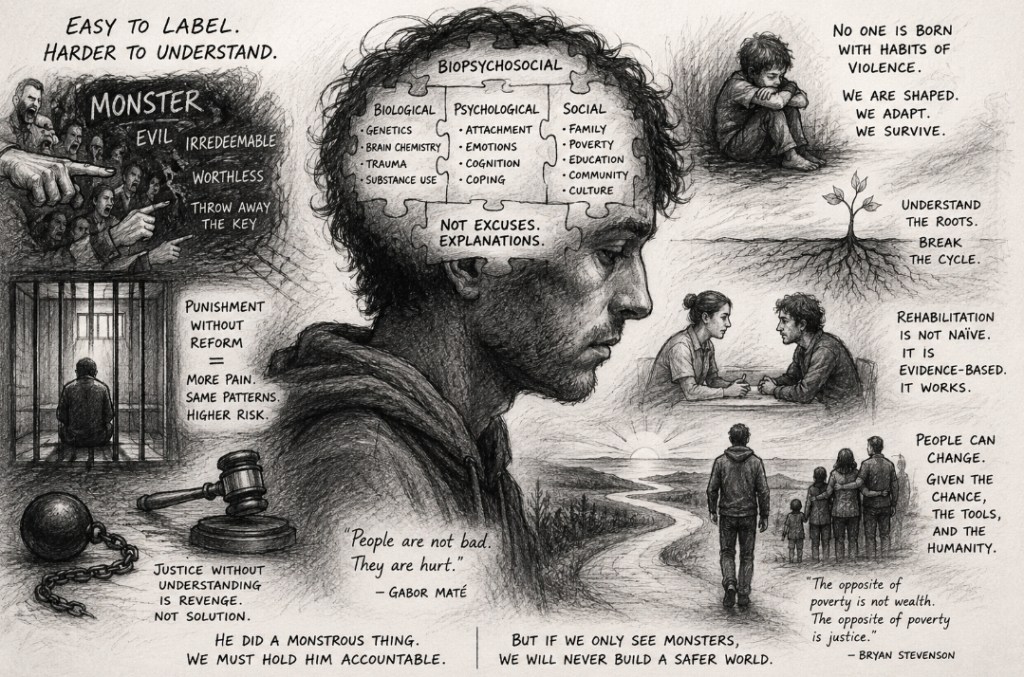
No one is born into the world with fixed habits of violence, cruelty, or emotional detachment. Humans are not static moral objects, they are developmental processes.
Behaviour is shaped over time through interaction between experience, biology, and environment.
The biopsychosocial model is essential here:
Biological factors: neurological development, impulse control, trauma effects on the brain, substance use
Psychological factors: attachment wounds, trauma responses, personality adaptation, coping mechanisms
Social factors: poverty, exposure to violence, neglect, peer environments, cultural conditioning
These forces do not excuse harmful behaviour, but they help explain its formation.
As psychiatrist Gabor Maté often argues (in various lectures and writings on trauma and addiction):
“People are not bad. They are hurt.”
The emphasis here is not denial of harm, but recognition that behaviour is often an adaptation to pain, not an expression of inherent evil.
A person does not wake up one day and become violent in a vacuum. They arrive there through layers, many of which were never chosen.
The Moment vs the Life
Society tends to collapse a lifetime into a single act.
One moment becomes the identity. Everything before it becomes irrelevant. Everything after it becomes punishment.
But psychologically, that moment is only the visible peak of a much longer process.
Questions that are often ignored include:
What attachment patterns shaped emotional regulation?
What forms of distress were never met with containment?
What behaviours were reinforced over time as survival strategies?
What social structures failed to intervene early?
The psychologist Alice Miller, known for her work on childhood trauma, wrote extensively on how early emotional injury shapes later behaviour:
“The truth about our childhood is stored in our body and lives in our emotions.”
In other words, the past does not disappear. It organizes how the present is experienced, and sometimes how harm is enacted.
Punishment Without Transformation
Many justice systems are structured around containment and retribution.
A person commits harm, they are removed, they are punished → the system considers the issue resolved.
But this model often stops short of asking whether anything has actually changed within the person.
Without intervention, imprisonment can become:
isolation without reflection
identity fixation (“offender” as permanent self)
reinforcement of shame rather than insight
absence of psychological rehabilitation
Philosopher Michel Foucault, in his analysis of punishment systems, suggested that modern punishment often shifts from the body to the identity:
“The soul is the prison of the body.”
Meaning: punishment does not only restrict freedom, it can shape how a person is defined forever.
When identity becomes fixed, transformation becomes harder to imagine.
Judgement and the Collapse of Complexity
Public reaction to serious crime often demands clarity.
We want clean moral categories:
good vs evil
victim vs monster
innocent vs irredeemable
But human psychology rarely operates in binaries.
The philosopher Hannah Arendt, in her work on moral responsibility and evil, introduced the idea of the “banality of evil,” suggesting that harmful acts can be carried out by ordinary individuals operating within systems, not by mythic monsters.
She is often paraphrased as noting:
“Most evil is done by people who never consider themselves evil.”
This is uncomfortable because it challenges the assumption that harm is always rooted in extraordinary depravity. Sometimes it is rooted in fragmentation, obedience, survival, or distorted meaning-making.
We Are Not Born With Habits
Habits are learned patterns of response.
A child is not born knowing how to regulate rage, tolerate abandonment, or process shame.
They learn through what is modelled, mirrored, reinforced, or punished.
If emotional needs are consistently unmet, the nervous system adapts:
hypervigilance replaces safety
aggression replaces expression
dissociation replaces overwhelm
These are not character flaws. They are survival strategies that outlive their original context.
Neuroscientist Bruce Perry has often emphasised that:
“The brain is shaped by experience.”
This is a foundational principle in trauma-informed care: what is repeated becomes wired.
Rehabilitation and the Question of Change
Sweden is often referenced in discussions of rehabilitative justice due to its emphasis on reintegration rather than purely punitive confinement.
The system prioritises:
education and vocational training
psychological support and therapy
maintaining family and social connections
preparing individuals for structured re-entry into society
The underlying assumption is not naïve optimism. It is pragmatic psychology: behaviour that is understood and treated is less likely to repeat than behaviour that is only punished.
The question becomes: Do we want systems that express moral outrage, or systems that reduce future harm?
Often, the two are treated as mutually exclusive, but they do not have to be.
Dehumanisation and Its Consequences
Calling someone a monster may feel emotionally satisfying, but it has consequences.
Dehumanisation:
reduces motivation to understand prevention
justifies harsher and less effective systems
flattens complexity into certainty
removes the possibility of transformation
Once someone is no longer seen as human, anything done to them becomes easier to justify.
But justice systems built only on removal and punishment rarely address the roots of harm. They respond to symptoms, not causes.
Accountability Without Erasure
A more psychologically informed approach does not remove responsibility.
It separates two ideas that are often incorrectly merged:
Accountability: acknowledging harm and consequences
Understanding: exploring how and why harm emerged
Both are necessary.
A system that only punishes risks repetition.
A system that only explains risks minimising harm.
The balance is uncomfortable, but essential.
Closing Reflection
The hardest position to hold is that a person can commit an act that is profoundly inhumane, and still be a human being shaped by forces we often prefer not to examine.
If we only see monsters, we miss the pathways that create them.
If we only see systems, we risk forgetting the reality of harm.
True psychological and social maturity may lie in the ability to hold both truths at once: that harm is real, and that it is also produced.
And if it is produced, it can also, at least in some cases—be prevented.


Leave a Reply